Gallery
Philosophical Surgical Operation (PSO)
Philosophical Surgical Operation (PSO)
Core Claim:
Governance operates not only through systems, but through intervention into the conditions under which systems interpret, stabilise, and act.
Philosophical Surgical Operations (PSO) formalise the structured application of interpretive discipline within live epistemic environments. Under conditions of signal pressure, narrative compression, and accelerated escalation, governance risk emerges not only from incorrect decisions, but from the premature collapse of interpretive space.
PSO intervenes at this level.
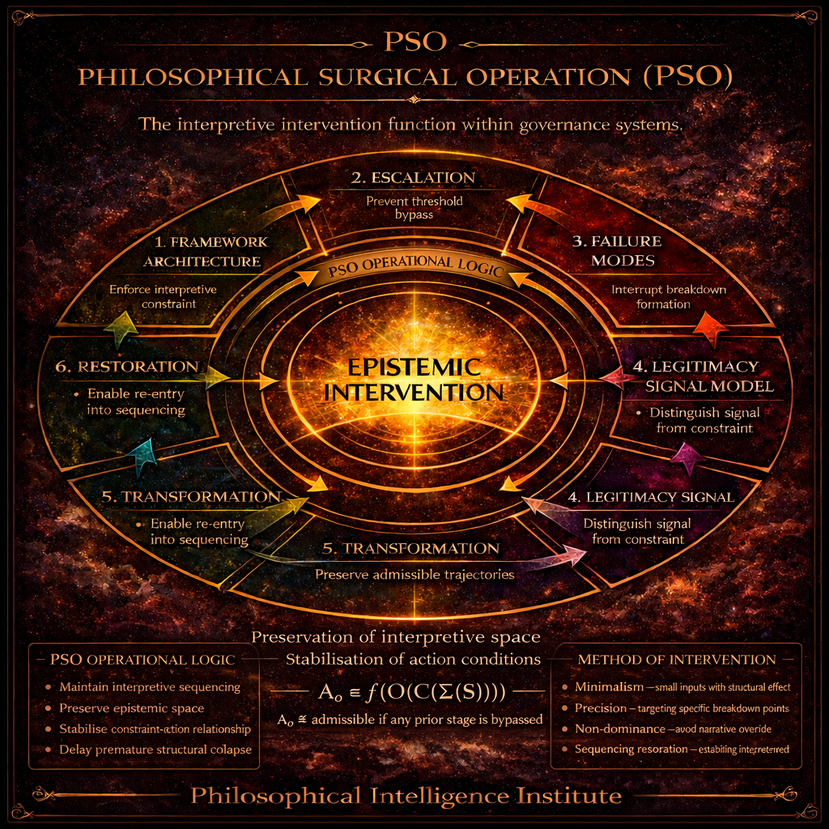

Philosophical Surgical Operation (PSO)
The diagram presents the Philosophical Surgical Operation (PSO) as the operational intervention layer within the Governance Operating System, centred on epistemic intervention—the structured stabilisation of interpretation under conditions of pressure.
At the core, PSO acts upon the interpretive field to preserve epistemic space, restore sequencing discipline, and prevent premature structural designation. The surrounding control rings represent the operational logic of intervention, mediating the relationship between signal, constraint, ontology, and action within dynamically evolving environments.
The outer cycle situates PSO across the full governance architecture.
Framework Architecture → Escalation → Failure Modes → Legitimacy Signal Model → Transformation → Restoration.
Each segment identifies a specific point at which interpretive breakdown may occur and where targeted intervention can restore admissible structure.
The governing condition is formalised as:
This establishes that valid action depends on the integrity of prior interpretive stages. PSO functions to ensure that this sequence is maintained, particularly under conditions of accelerated signal flow, narrative compression, and structural instability.
The lower panels define the method of intervention:
minimal, precise, and non-dominant inputs designed to restore interpretive order without overriding discourse.
In this sense, PSO does not resolve systems directly; it restructures the conditions under which systems can resolve themselves.
The diagram therefore defines governance intervention not as the imposition of outcomes, but as the preservation and restoration of the conditions under which valid outcomes become possible.
Definition
A Philosophical Surgical Operation is a targeted, minimal, and structurally precise intervention into an active interpretive environment, designed to:
- restore sequencing discipline
- preserve epistemic space
- prevent premature structural designation
- stabilise the conditions under which admissible action becomes possible
PSO does not impose conclusions.
It regulates the conditions under which conclusions can be validly formed.
It regulates the conditions under which conclusions can be validly formed.
Structural Position
PSO operates across the Governance Operating System as an intervention layer:
- within Framework Architecture, it enforces interpretive constraint
- within Escalation, it prevents threshold bypass
- within Failure Modes, it identifies and interrupts breakdown formation
- within Legitimacy Signal Model, it distinguishes signal from constraint
- within Transformation, it preserves admissible trajectories
- within Restoration, it enables re-entry into disciplined sequencing
PSO is therefore not a separate model, but a cross-cutting operational function.
Operational Logic
Under conditions of high signal velocity:
- interpretation compresses
- narratives stabilise prematurely
- admissible pathways narrow
- action risks structural misalignment
PSO responds by:
- reintroducing intermediate analytical steps
- maintaining multiple admissible interpretations
- delaying premature closure
- stabilising the relationship between signal, constraint, and ontology
The objective is not to slow systems arbitrarily, but to ensure that action emerges from valid structure rather than compressed signal.
PSO interventions operate in alignment with the Post-Semiotic Protocol (PSP), ensuring that sequencing discipline is preserved even where interpretive structures are unstable or degraded.
Method of Intervention
PSO interventions are characterised by:
- Minimalism — small inputs with structural effect
- Precision — targeting specific breakdown points
- Non-dominance — avoiding narrative override
- Sequencing restoration — re-establishing interpretive order
A successful intervention does not resolve the discourse.
It restructures it.
It restructures it.
Failure Sensitivity
PSO is most critical under conditions where:
- interpretive inflation is accelerating
- legitimacy functions as signal rather than constraint
- escalation bypasses admissibility thresholds
- systems stabilise within failure modes (especially containment and simulation)
In such environments, direct argument often fails.
Intervention must occur at the level of interpretive structure.
Intervention must occur at the level of interpretive structure.
Analytical Function
PSO enables:
- detection of epistemic space contraction
- identification of premature structural designation
- restoration of admissible sequencing
- stabilisation of interpretive conditions under pressure
It converts governance from passive analysis into active structural mediation.
Relation to Admissibility
PSO operates within the admissibility framework:
The role of PSO is to ensure that this sequence is not collapsed under pressure.
Application Domain
PSO applies to:
- geopolitical discourse environments
- institutional decision-making under stress
- media and narrative formation systems
- high-velocity information environments (including AI-mediated systems)
It is particularly effective where:
- interpretation precedes action
- signals are amplified faster than they can be processed
- governance depends on maintaining structural coherence
Clarification
PSO is not persuasion.
It is not rhetoric.
It is not advocacy.
It is not rhetoric.
It is not advocacy.
It does not seek to win arguments or impose positions.
It defines and restores the conditions under which interpretation remains valid and action becomes structurally justified.
Position Within the Research Architecture
PSO represents the operational extension of the Philosophical Intelligence system.
It connects:
- PIE — interpretive discipline
- IOM — structural classification
- LSM — legitimacy dynamics
- CGF — constraint governance
- PSG — post-semiotic conditions
and applies them within live environments where interpretive stability is at risk.
Final Statement
Governance fails not only when decisions are wrong, but when action is taken before it becomes admissible.
Philosophical Surgical Operations address this failure at its source.
They do not determine what should be done.
They ensure that what is done emerges from conditions in which it can be validly known.
They ensure that what is done emerges from conditions in which it can be validly known.