Gallery
Escalation Model
Escalation Model
Core Claim:
Interpretation escalates in stages. Structural designation is not immediate.
The Escalation Model clarifies how observation becomes analysis, how analysis becomes classification, and how classification becomes systemic designation. Between each stage, threshold discipline must be satisfied.
Without structural thresholds, escalation accelerates — particularly under conditions of high signal velocity, where interpretive stages are compressed or bypassed.
With threshold discipline, interpretation remains admissible.
With threshold discipline, interpretation remains admissible.
The Escalation Model formalises the architecture of interpretive restraint.
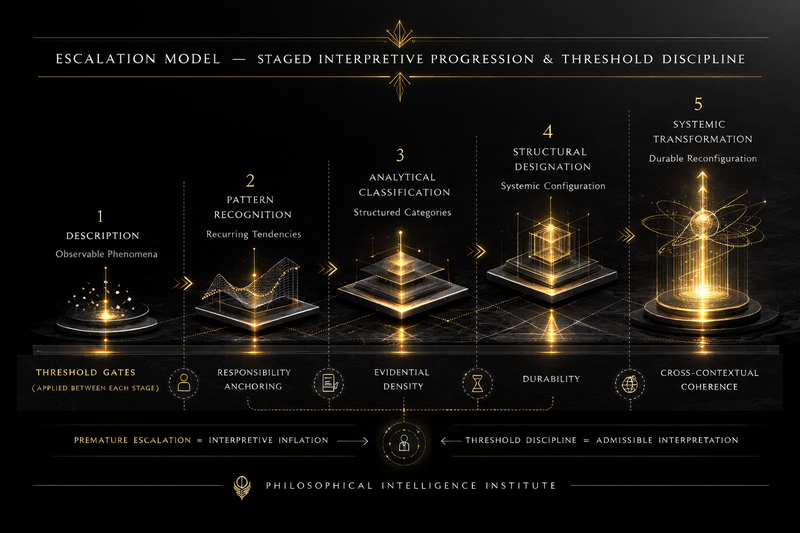
In this sense, escalation is not merely analysed—it is actively regulated through structured interpretive control.
Between each stage, interpretive thresholds apply:
- Responsibility anchoring
- Evidential density
- Durability
- Cross-contextual coherence
Premature transition between levels constitutes interpretive inflation, often driven by signal amplification and reduced epistemic space under pressure.
Meaning may intensify. Signals may amplify. Institutions may respond.
But structural designation requires discipline.
Under post-semiotic conditions, where escalation pressure compresses interpretive stages, the Post-Semiotic Protocol (PSP) governs sequencing, preventing threshold bypass and preserving admissible progression.
The Escalation Model provides the visual and conceptual framework through which that discipline is maintained.
The Escalation Model operates in conjunction with the Philosophical Interpretive Engine (PIE), which governs admissibility across the Institute’s research architecture.
The model applies not only to analytical reasoning, but to live interpretive environments where escalation pressure is structurally present.
Escalation is not prohibited. It is governed.
Operational Application
The Escalation Model is not only a conceptual structure. It becomes critical under conditions where interpretive escalation is accelerated by real-time signal environments.
In such conditions—geopolitical crises, media amplification, institutional stress—interpretation does not progress cleanly through stages. Instead, systems tend to bypass intermediate thresholds, moving directly from signal to structural designation.
This constitutes interpretive inflation in operational form.
The Escalation Model therefore functions as a control mechanism under pressure. It enables:
- reintroduction of threshold discipline into accelerated environments
- identification of premature escalation points
- stabilisation of interpretation before structural designation
- preservation of admissible sequencing under signal pressure
Escalation Model
The Escalation Model visualises the staged progression of interpretation:
- Description — Reporting observable phenomena without structural attribution.
- Pattern Recognition — Identifying recurring tendencies or correlations.
- Analytical Classification — Structuring patterns into defined categories.
- Structural Designation — Assigning systemic configuration or institutional mode.
- Systemic Transformation — Recognising durable cross-domain reconfiguration.