Gallery
Governance Operating System (GOS)
Governance Operating System (GOS)
Core Claim:
Governance systems are not static arrangements.
They operate within a constrained admissibility landscape, governed by structured interpretation, threshold discipline, and dynamic transformation under pressure. Governance is mediated not only through decision-making, but through the structuring and preservation of epistemic space—the conditions under which interpretation remains valid and action becomes possible.
Under conditions of complexity and signal acceleration, governance begins not with action, but with the maintenance of interpretive integrity.
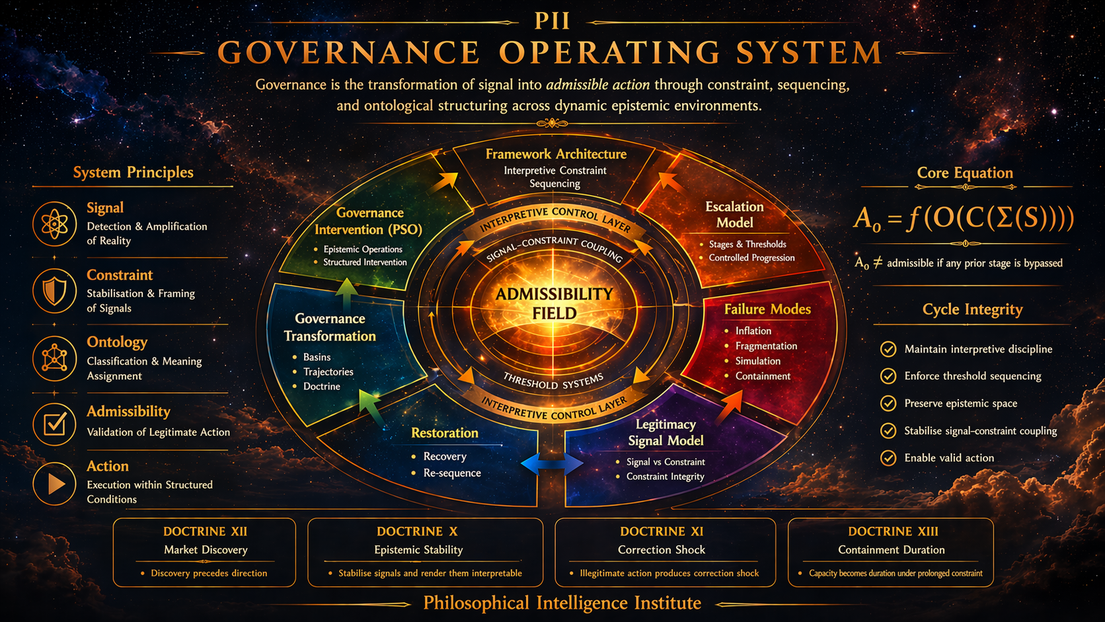
Figure — Governance Operating System (GOS)
The diagram presents the Governance Operating System (GOS) as an integrated, closed-loop architecture in which interpretation, escalation, failure, legitimacy dynamics, transformation, restoration, and intervention are unified within a central admissibility field.
At the core, governance is defined as the transformation of signal into structurally valid action through constraint, sequencing, and ontological classification. The surrounding interpretive control layer enforces threshold discipline, preserves epistemic space, and stabilises the relationship between signal and structure under conditions of pressure.
The outer system illustrates the full governance cycle:
Framework Architecture → Escalation → Failure Modes → Legitimacy Signal Model → Governance Transformation → Restoration → Intervention (PSO).
These components operate not as isolated models, but as interdependent functions within a dynamic admissibility terrain.
Framework Architecture → Escalation → Failure Modes → Legitimacy Signal Model → Governance Transformation → Restoration → Intervention (PSO).
These components operate not as isolated models, but as interdependent functions within a dynamic admissibility terrain.
The governing equation formalises the system:
This condition establishes that action becomes valid only when all prior stages—signal processing, constraint application, and ontological structuring—are satisfied. Failure to maintain this sequence results in interpretive inflation, misclassification, and structurally invalid intervention.
The diagram therefore defines governance not as decision-making alone, but as the continuous maintenance of the conditions under which valid action becomes possible. Under conditions of complexity and accelerated signal environments, governance operates primarily through the preservation and structuring of epistemic space.
I. Framework Architecture
Core Claim
Disciplined interpretation requires structured sequencing and threshold control.
Meaning, interpretation, admissibility, issue configuration, legitimacy designation, and governance classification are not isolated domains. They operate within an integrated system governed by evidential thresholds, responsibility anchoring, and structural discipline.
Without this structure, interpretive inflation occurs: signals are misread as structures, and provisional narratives are treated as reality. With it, analytical restraint is preserved and governance classification remains accountable.
Structural Sequence
Interpretation proceeds through a disciplined progression:
Meaning → Interpretation → Admissibility → Issue Configuration → Legitimacy Designation → Governance Classification
The Philosophical Interpretive Engine (PIE) governs this sequence, enforcing constraint prior to escalation. The admissibility layer ensures that structural claims are made only where evidential density, durability, and cross-contextual coherence are satisfied.
Integrated System
The architecture integrates:
- PIE — interpretive constraint and admissibility
- MoMean — formation and stability of meaning
- MM — transformation within interpretive fields
- IOM — classification and sequencing of issues
- CGF — governance under constraint
- LSM — legitimacy as signal vs constraint
- ISM / ORM — system stress and reconfiguration
- PSG — limits of signification under pressure
- TTL / TSM — trauma as structuring force of order
Operational Application
Under conditions of live signal pressure—geopolitical crises, institutional stress, accelerated information environments—interpretation becomes unstable. Systems compress complexity into singular narratives, reducing epistemic space and increasing the risk of premature structural designation.
The Framework Architecture therefore functions not only as a descriptive system, but as a method of structured intervention:
- preserving epistemic space under pressure
- preventing premature escalation from signal to structure
- maintaining multiple admissible interpretations
- stabilising the conditions under which governance classification becomes valid
Governance begins at the level of interpretive discipline.
II. Escalation Model
Core Claim
Interpretation escalates in stages. Structural designation is not immediate.
Escalation is governed by thresholds. Without discipline, escalation accelerates—particularly under high signal velocity, where interpretive stages are compressed or bypassed.
Escalation Structure
Description → Pattern Recognition → Analytical Classification → Structural Designation → Systemic Transformation
Between each stage, threshold conditions apply:
- Responsibility anchoring
- Evidential density
- Durability
- Cross-contextual coherence
Premature transition constitutes interpretive inflation.
Operational Function
In real environments, escalation rarely proceeds linearly. Systems under pressure bypass intermediate thresholds, moving directly from signal to structural claim.
The Escalation Model therefore operates as a control system:
- reintroducing threshold discipline under acceleration
- identifying points of premature escalation
- stabilising interpretation prior to structural designation
- preserving admissible sequencing
Escalation is not prohibited. It is governed.
III. Failure Modes
Core Claim
Interpretation governs systems—until its thresholds fail.
Failure does not require collapse. Systems may remain stable while interpretive discipline erodes.
Failure Patterns
When threshold discipline fails, four structural conditions emerge:
- Inflation (PIE) — premature structural designation
- Fragmentation (IOM / MoMean) — divergence of interpretive structures
- Simulation (LSM) — legitimacy persists as signal without constraint
- Containment (CGF) — stability without transformation
These are structural conditions, not moral judgments.
Operational Detection
Failure modes emerge progressively:
- narrowing of interpretive range
- substitution of signal for structure
- premature closure under pressure
The model functions as an early warning system:
- detecting inflation during formation
- identifying fragmentation across ontologies
- recognising simulation in legitimacy systems
- diagnosing containment under prolonged constraint
Governance failure is not a discrete event, but a progressive deviation from admissible sequencing.
IV. Legitimacy Signal Model (LSM)
Core Claim
Authority can persist without being constrained by legitimacy when legitimacy functions as signal rather than boundary.
Legitimacy may remain visible, articulated, and institutionally embedded while losing its capacity to regulate outcomes.
Structural Condition
Under LSM:
- legitimacy becomes procedural or performative
- authority continues without veto constraint
- critique is absorbed rather than transformative
This condition emerges structurally and does not require bad faith.
Operational Implications
When legitimacy functions as signal:
- systems become resistant to correction
- dissent is processed but does not alter outcomes
- stability persists despite structural misalignment
Governance analysis must distinguish between:
- legitimacy as constraint
- legitimacy as signal
Where legitimacy no longer constrains, intervention must shift from normative critique to structural reconfiguration.
V. Governance Transformation Model
Core Claim
Governance systems operate within a dynamic admissibility terrain and transform through structurally defined trajectories.
Structural Components
- Doctrine Stack (I–X) — constraint system governing admissibility and sequencing
- Admissibility Basin — structural field of stability and instability
- Transformation Trajectories — reconfiguration, collapse, competition, mediation, capture
System Behaviour
Governance stability depends on remaining within admissible regions.
Transformation occurs through:
- shifts in constraint conditions
- basin deformation under pressure
- movement across structural states
Operational Extension
Under high-pressure conditions:
- interpretive systems compress complexity
- epistemic space narrows
- action risks premature stabilisation
The model enables:
- preservation of interpretive flexibility
- maintenance of admissible pathways
- stabilisation of signal–constraint–action relationships
Governance is not only evolutionary—it is mediated through interpretive structure.
VI. Restoration Model
Core Claim
Interpretive breakdown is not terminal.
Restoration begins through the re-establishment of admissibility conditions.
Restoration Sequence
De-Escalation → Re-Anchoring → Re-Sequencing → Re-Designation → Stabilisation
Restoration is not rhetorical moderation.
It is structural recalibration.
It is structural recalibration.
Operational Re-Entry
Restoration can begin within failure conditions:
- identification of breakdown during stability
- withdrawal or reclassification of premature claims
- reintroduction of evidential grounding
- restoration of sequencing discipline
Governance capacity is recoverable through re-entry into admissibility.
VII. Governance Intervention (PSO)
Core Claim
Governance operates not only through systems, but through intervention into the conditions of interpretation.
Philosophical Surgical Operations (PSO)
PSO represents the operational application of the PII framework in live environments.
Under conditions of signal pressure:
- interpretive systems collapse into narrative certainty
- admissible pathways narrow
- governance risks misalignment
PSO intervenes by:
- reintroducing sequencing discipline
- preserving epistemic space
- preventing premature structural closure
- stabilising interpretive conditions
Function
PSO does not impose conclusions.
It:
- expands interpretive capacity
- delays premature closure
- enables valid action
Final Statement
The Governance Operating System defines a complete cycle:
Interpretation → Escalation → Failure → Restoration → Transformation → Intervention
Governance is not the act of choosing what to do.
It is the process of maintaining the conditions under which action becomes structurally valid.
Under conditions of complexity, pressure, and acceleration, the central task of governance is not control—but the preservation of admissible structure within evolving epistemic space.
Within the Governance Operating System, the Post-Semiotic Protocol (PSP) functions as the sequencing layer that governs progression under conditions where signification alone cannot stabilise interpretation.