Gallery
Interpretive Failure
Interpretive Failure
Core Claim:
The model applies both to analytical systems and to live governance environments where interpretive discipline is under pressure.
Interpretation governs systems — until its thresholds fail.
When interpretive discipline weakens — particularly under conditions of high signal pressure —, escalation continues without admissibility. Structural designation outpaces evidential grounding. Legitimacy becomes signal rather than constraint, weakening its capacity to regulate action. Governance stabilises through containment rather than transformation.
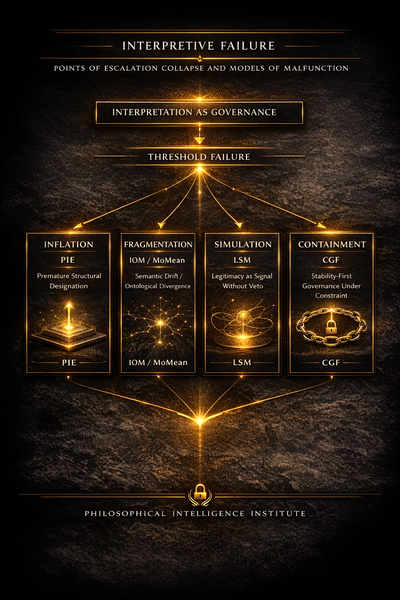
The Failure Modes diagram maps the structural consequences of threshold collapse.

The model can therefore be applied as an early warning system. It enables:
- detection of inflation at the point of premature structural designation
- identification of fragmentation through divergence in underlying ontologies
- recognition of simulation where legitimacy persists without constraint
- diagnosis of containment where systems stabilise without transformation
In this sense, failure is not only analysed retrospectively. It can be recognised during formation and, where possible, stabilised through the reintroduction of threshold discipline and preservation of epistemic space.
The diagram clarifies that failure does not require collapse. Systems may remain stable while interpretive discipline erodes.
The Failure Modes model visualises what occurs when interpretive escalation proceeds without sufficient responsibility anchoring, evidential density, durability, or cross-contextual coherence.
These failure modes are diagnostic categories. They describe structural conditions, not moral judgments.
These failure modes are diagnostic categories. They describe structural conditions, not moral judgments.
Operational Detection and Stabilisation
While the Failure Modes model is presented as a diagnostic framework, its function extends into the identification and interruption of interpretive breakdown under live conditions.
In high-pressure environments, failure modes do not appear fully formed. They emerge progressively through small deviations in interpretive discipline—premature escalation, narrowing of interpretive range, or substitution of signal for structure.
In advanced failure states, sequencing itself becomes unstable. The Post-Semiotic Protocol (PSP) provides the structural mechanism through which interpretive order can be re-established where signification alone is insufficient.
Interpretive Failure
Interpretation functions as governance: it assigns structural meaning, classifies issues, designates legitimacy, and defines systemic conditions.
When threshold discipline fails, four distinct failure patterns emerge:
Inflation — (PIE)
Premature structural designation.
Observation escalates directly into systemic claim without admissible grounding.
Premature structural designation.
Observation escalates directly into systemic claim without admissible grounding.
Fragmentation — (IOM / MoMean)
Semantic drift and ontological divergence.
Shared language masks incompatible interpretive structures.
Semantic drift and ontological divergence.
Shared language masks incompatible interpretive structures.
Simulation — (LSM)
Legitimacy persists as signal without veto.
Authority continues while legitimacy becomes proceduralised and post-hoc.
Legitimacy persists as signal without veto.
Authority continues while legitimacy becomes proceduralised and post-hoc.
Containment — (CGF)
Stability-first governance under constraint.
Institutional energy shifts from transformation to risk management and continuity.
Stability-first governance under constraint.
Institutional energy shifts from transformation to risk management and continuity.
The Failure Modes model operates within the Philosophical Intelligence research architecture as a structural map of escalation collapse and analytic malfunction.